Understanding this, call(), apply(), and bind() in JavaScript
JavaScript has many confusing things, but this is probably in the top three. The other two are usually why something works and why it stopped working after you touched it.
But the idea behind this is actually simple.
thisrefers to the object that is calling the function.
Think of it as answering the question:
“Who called this function?”
What this Means in JavaScript
In JavaScript,
thisrefers to the object that is executing the current function.A simple way to remember:
this = the caller of the function
- If the caller changes,
thischanges.
Function → Caller Relationship

- Think of it like this:
object → calls → function
           ↓
         this = object
this Inside Normal Functions
In a regular function,
thisdepends on how the function is called.Example:
function greet() {
  console.log(this);
}

greet();
- In a browser environment, this will usually print:
Window
Why?
Because the function was called globally, so the caller becomes the global object.
This is why beginners often look at
thisand say:
“I didn’t ask for the entire window.”
- JavaScript simply replies: “Too bad.”
this Inside Objects
- When a function is inside an object,
thisrefers to the object that owns the method.
Example:
const person = {
  name: "Rahul",

  greet: function () {
    console.log("Hello, my name is " + this.name);
  }
};

person.greet();
Output:
Hello, my name is Rahul
Here:
person → calls → greet()
this = person
So this.name becomes "Rahul".
What call() Does
Sometimes we want to borrow a function from another object.
call()allows us to manually set whatthisshould be.
Example:
const person1 = {
  name: "Rahul"
};

const person2 = {
  name: "Aman"
};

function greet() {
  console.log("Hello " + this.name);
}

greet.call(person1);
greet.call(person2);
Output:
Hello Rahul
Hello Aman
Explanation:
call(object)
- This forces the function to run with that object as
this.
call() With Arguments
call()can also pass arguments.
function introduce(city) {
  console.log(this.name + " lives in " + city);
}

const person = { name: "Rahul" };

introduce.call(person, "Delhi");
Output:
Rahul lives in Delhi
What apply() Does
apply() works almost the same as call().
- The only difference is how arguments are passed.
call() → arguments separately
apply() → arguments inside an array
Example:
function introduce(city, country) {
  console.log(this.name + " lives in " + city + ", " + country);
}

const person = { name: "Rahul" };

introduce.apply(person, ["Delhi", "India"]);
Output:
Rahul lives in Delhi, India
So remember:
call()  → arguments separately
apply() → arguments as an array
What bind() Does
bind() is slightly different.
- Instead of immediately calling the function, it returns a new function with
thispermanently set.
Example:
function greet() {
  console.log("Hello " + this.name);
}

const person = { name: "Rahul" };

const greetPerson = greet.bind(person);

greetPerson();
Output:
Hello Rahul
Explanation:
bind() → returns a new function
It does not run immediately.
Think of it like saving a customized function for later.
Difference Between call, apply, and bind
| Method | Runs Immediately? | Arguments Format | Returns Function? |
|---|---|---|---|
| call() | Yes | Separate arguments | No |
| apply() | Yes | Array of arguments | No |
| bind() | No | Separate arguments | Yes |
Quick summary:
call()  → run now
apply() → run now (array args)
bind()  → run later
Visual Comparison
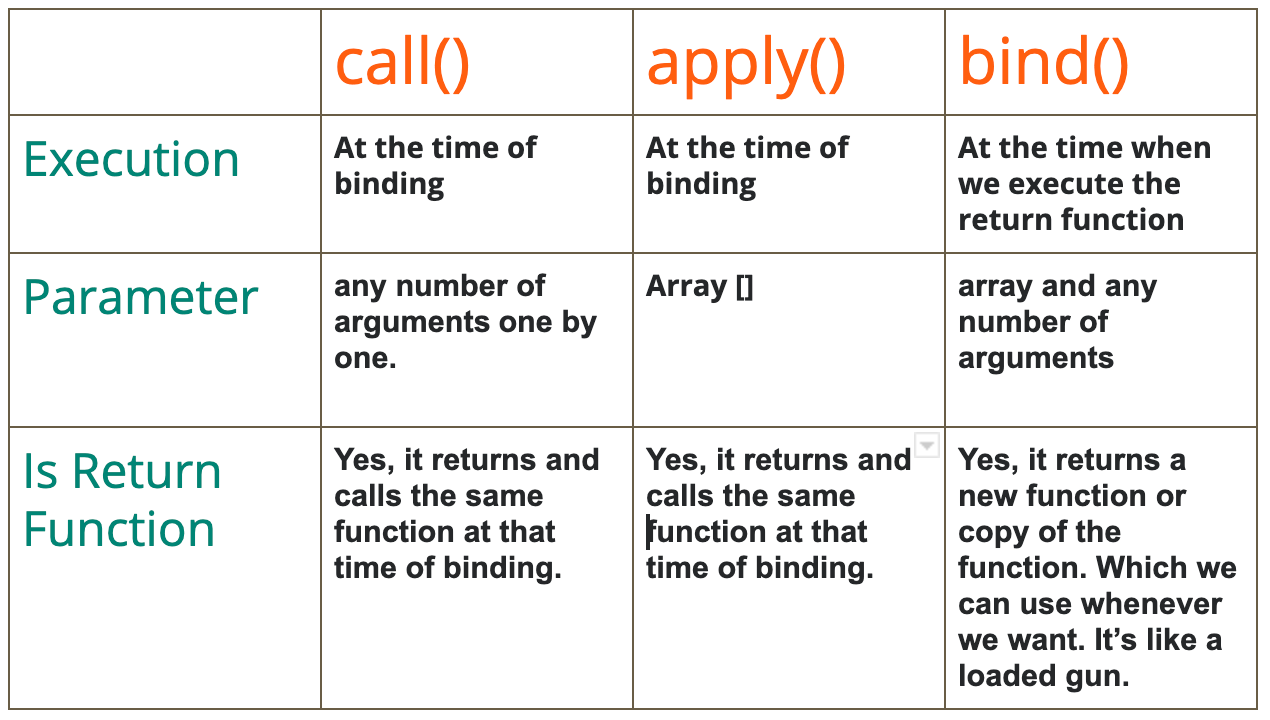
Conceptually:
call()  → run function with chosen this
apply() → same but arguments in array
bind()  → create new function with fixed this
Assignment
Step 1: Create an Object with a Method
const person = {
  name: "Rahul",

  greet: function () {
    console.log("Hello " + this.name);
  }
};
Step 2: Borrow the Method Using call()
const anotherPerson = { name: "Aman" };

person.greet.call(anotherPerson);
Expected Output
Hello Aman
Step 3: Use apply() with Array Arguments
function introduce(city, country) {
  console.log(this.name + " lives in " + city + ", " + country);
}

const person = { name: "Rahul" };

introduce.apply(person, ["Delhi", "India"]);
Step 4: Use bind()
function greet() {
  console.log("Hello " + this.name);
}

const person = { name: "Rahul" };

const greetPerson = greet.bind(person);

greetPerson();
Final Thoughts
Understanding this, call(), apply(), and bind() is essential in JavaScript because they control how functions receive their context.
A good rule to remember:
If JavaScript behaves strangely, check what
thisis.
So so grateful to the #chaicode team for the opportunities.

